
Automated production lines run on thousands of small, precise movements happening constantly, all day, without anyone watching each one individually. A valve opens. An actuator responds. Air pressure shifts. A process step completes and the next one starts. All of that depends on a component most people never think about — the rubber diaphragm sitting inside the pneumatic valve making it all possible.
It’s easy to overlook. It’s small, it’s inexpensive relative to the equipment around it, and when it’s working, nobody notices it at all. But in automated and industrial equipment specifically, this one flexible membrane has an outsized influence on how accurately a valve responds, how efficiently an actuator performs, and how much unplanned downtime a plant deals with over a year.
This guide walks through exactly how rubber diaphragms function inside pneumatic valve systems, which materials actually fit which applications, and what keeps automated equipment running reliably instead of becoming a maintenance headache.
Why Pneumatic Valve Performance Depends on the Right Rubber Diaphragm
Downtime is expensive — genuinely expensive, often running into thousands of dollars an hour once lost production is factored in. And compressed air systems, which power the pneumatic valves this article is about, account for a meaningful share of total industrial electricity use across most manufacturing facilities. Put those two facts together and the diaphragm stops looking like a minor component and starts looking like exactly what it is: a part that directly affects both uptime and energy cost.
A pneumatic valve is only as reliable as its diaphragm. Get the material and design right, and the valve responds consistently for years. Get it wrong, and you’re looking at drifting accuracy, energy waste from air leakage, and failures that show up at the worst possible time — usually mid-cycle, on equipment that was supposed to be running unattended.
How Rubber Diaphragms Work Inside Pneumatic Valves
The mechanics here are simpler than people expect, which is part of why the component gets overlooked.
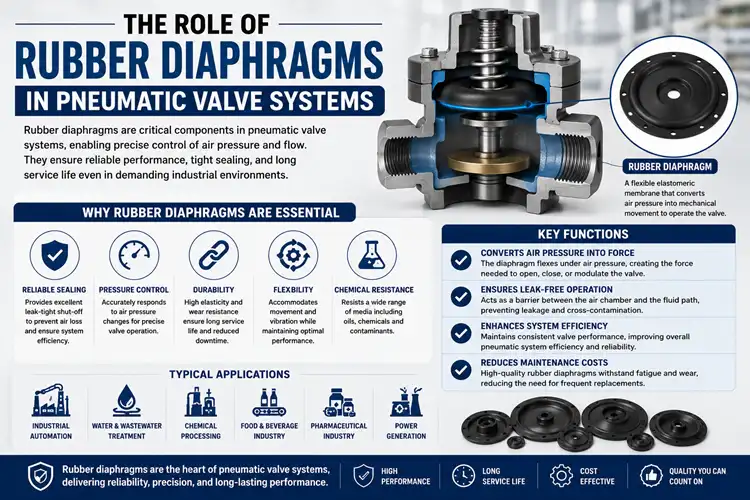
A pneumatic valve diaphragm sits between two chambers, flexing back and forth as air pressure changes on either side of it. That flexing motion is what actually transmits force — pressure differential on one side pushes the diaphragm, and that movement drives the valve stem, opening or closing the valve or shifting the actuator’s position. No pressure differential, no movement, no valve response.
The diaphragm is doing double duty here: it’s a flexible membrane transmitting mechanical force, and at the same time it’s maintaining an airtight seal between the two chambers so the pressure differential can actually build in the first place. If either job fails, the whole valve stops responding correctly.
Key Functions of Rubber Diaphragms in Pneumatic Actuators
Inside a pneumatic actuator, the diaphragm handles several jobs simultaneously. It transmits force from air pressure into mechanical motion, precisely enough that automated systems can rely on it for accurate valve positioning. It maintains a leak-free seal between pressure chambers, which is what allows the pressure differential to actually do its job instead of quietly bleeding away. It absorbs the mechanical stress of constant flexing, cycle after cycle, without losing its shape. And it does all of this while responding fast enough that automation systems calling for rapid valve actuation don’t get delayed waiting on the diaphragm to catch up.
In a manually operated valve, small inconsistencies in diaphragm performance might go unnoticed. In an automated system running thousands of cycles a day, they show up immediately as drift in valve accuracy or actuator response time.
Common Rubber Diaphragm Materials and Their Applications
Material selection is really the whole ballgame here — the same valve design performs completely differently depending on what the diaphragm is made from.
EPDM
EPDM handles water, steam, and general weathering better than most alternatives, making it a strong, cost-effective choice for pneumatic valves in water treatment, HVAC, and general industrial automation where aggressive chemical exposure isn’t the main concern.
NBR
NBR is built specifically for oil and fuel resistance, which makes it the standard choice for pneumatic valves in hydraulic systems, oil and gas equipment, and machinery where petroleum-based fluids are a constant presence.
FKM (Viton)
Viton steps in wherever chemical resistance and higher operating temperatures both matter — chemical processing valves, high-temperature pneumatic systems, and applications where a standard elastomer would degrade too quickly to be practical.
Silicone
Silicone covers the applications where FDA compliance and a wide temperature range matter most — pharmaceutical, food processing, and medical equipment where the diaphragm needs to stay flexible and compliant across sterilization cycles.
PTFE Bonded Diaphragms
PTFE-bonded diaphragms exist for the most aggressive chemical environments, where even Viton isn’t resistant enough. They combine an elastomer base with a PTFE-bonded surface, giving valves in highly corrosive chemical processing applications a level of chemical resistance the standard materials simply can’t match on their own.
Fabric Reinforced Rubber Diaphragms vs Standard Rubber Diaphragms
For pneumatic valves running at higher pressure, high cycle counts, or both, a standard molded diaphragm often isn’t enough on its own. Fabric reinforced rubber diaphragms solve this by embedding reinforcement layers directly into the elastomer, which delivers meaningfully higher burst strength, better fatigue resistance across repeated cycling, a longer service life overall, and improved dimensional stability that keeps the diaphragm performing consistently instead of gradually stretching out of spec.
For most heavy-duty industrial automation applications — where the valve is cycling constantly and downtime is expensive — fabric reinforcement isn’t a premium upgrade. It’s closer to a baseline requirement.
Common Causes of Pneumatic Valve Diaphragm Failure
Diaphragm failure in pneumatic valves tends to trace back to a short list of causes: the wrong elastomer for the actual media or chemical exposure, excessive operating pressure beyond the diaphragm’s rating, thermal cycling that accelerates fatigue faster than constant heat alone would, mechanical wear from repeated flexing over enough cycles, and poor installation that puts uneven stress on the diaphragm from day one.
Most of these are fully preventable with correct material selection and proper installation upfront — which is exactly why so many failures in automated equipment turn out to be avoidable in hindsight.
How to Extend Rubber Diaphragm Service Life
This is where predictive maintenance earns its reputation as more than a buzzword. Regular diaphragm inspection catches early wear indicators — small cracks, early signs of compression set, subtle changes in valve response time — well before they turn into an actual failure. Preventive replacement based on cycle count and observed wear, rather than waiting for a failure to force the issue, is what actually reduces unexpected shutdowns in automated systems where downtime is expensive.
A few habits make the biggest difference: track cycle counts against the diaphragm’s rated service life, watch for gradual changes in valve response time as an early warning sign, keep an eye on air consumption since leakage often shows up as an efficiency problem before it shows up as an outright failure, and build diaphragm replacement into scheduled maintenance windows instead of treating it as an emergency repair.
Energy efficiency ties directly into this too — a diaphragm that’s starting to leak doesn’t just risk failure, it’s actively wasting compressed air, which is expensive to generate. Catching that early through routine monitoring pays for itself in lower operating costs, separate from the downtime it prevents.
Industries That Depend on Pneumatic Valve Diaphragms
Pneumatic valve diaphragms show up across a wide range of industries: oil and gas, pharmaceutical manufacturing, chemical processing, food processing, water treatment, beverage production, mining, HVAC systems, power generation, semiconductor manufacturing, medical equipment, industrial automation broadly, packaging, general pneumatic machinery, and OEM equipment manufacturing across nearly all of the above.
What connects all of them is the same underlying need — a valve that responds accurately, seals reliably, and keeps doing both across enough cycles to make the equipment worth building in the first place.
Choosing the Right Rubber Diaphragm Manufacturer
Not every diaphragm supplier is actually equipped to solve this problem well. Look for a manufacturer with real in-house mold design and rubber compounding, genuine fabric reinforcement capability, PTFE and other bonding options when the application calls for it, actual burst and performance testing rather than assumptions, and enough manufacturing experience to understand why a diaphragm fails in a given application — not just how to mold one.
A manufacturer who can explain why a particular material or reinforcement makes sense for your specific valve is worth more than one simply offering the lowest price on a generic part.
Frequently Asked Questions
What is a rubber diaphragm? A flexible elastomer membrane that transmits pressure and maintains a seal between two chambers, commonly used inside pumps, valves, and pneumatic actuators.
What does a pneumatic diaphragm do? It converts air pressure differential into mechanical motion, driving valve or actuator movement while maintaining an airtight seal between pressure chambers.
How does a diaphragm valve work? Air pressure on one side of the diaphragm creates a pressure differential that flexes the membrane, which in turn moves the valve stem to open or close the valve.
What is a pneumatic actuator diaphragm? The flexible membrane inside a pneumatic actuator that transmits air pressure into the mechanical force needed to move a valve or control element.
Which material is best for pneumatic valve diaphragms? It depends on the application — EPDM for water and general use, NBR for oil exposure, Viton for chemicals and heat, and silicone for FDA-compliant applications.
How long do rubber diaphragms last? It varies by material, pressure, and cycle frequency, but properly specified diaphragms can reliably handle millions of cycles before replacement is needed.
When should a pneumatic diaphragm be replaced? Based on cycle count, observed wear, or changes in valve response time — not simply on a fixed calendar schedule.
How do I choose the right diaphragm material? Match the material to your actual chemical exposure, temperature range, and pressure requirements rather than defaulting to whatever was used previously.
What causes pneumatic diaphragm failure? Most commonly the wrong elastomer for the application, excessive pressure, thermal cycling, mechanical wear, or poor installation.
Can rubber diaphragms withstand chemicals? Yes, when the material is matched correctly — Viton and PTFE-bonded diaphragms offer the strongest resistance to aggressive chemical exposure.
What is the difference between rubber and PTFE diaphragms? Standard rubber diaphragms rely on the elastomer itself for chemical resistance, while PTFE-bonded diaphragms add a PTFE surface for chemical resistance beyond what rubber alone can provide.
Are fabric reinforced diaphragms better? For high-pressure or high-cycle applications, yes — they offer significantly better burst strength and fatigue resistance than standard molded diaphragms.
How much pressure can a rubber diaphragm handle? It depends heavily on the specific design and reinforcement, so pressure rating should always be confirmed against the manufacturer’s actual specification for that diaphragm.
How does diaphragm performance affect automation accuracy? A worn or degraded diaphragm responds less precisely to pressure changes, which shows up as drift in valve timing and positioning across automated cycles.
Can rubber diaphragms be custom manufactured? Yes — material, reinforcement, geometry, and bonding options can all be engineered around a specific valve or actuator design.
The Bottom Line
In pneumatic valve systems, the rubber diaphragm isn’t a background component — it’s the part actually doing the work of translating air pressure into precise, repeatable motion. In automated and industrial equipment specifically, where valves cycle constantly and downtime carries a real cost, getting the material, reinforcement, and design right isn’t optional engineering polish. It’s what determines whether the system runs reliably for years or becomes a recurring maintenance problem.
Whether you’re designing a new pneumatic control system or replacing worn valve components, selecting the right rubber diaphragm directly impacts reliability, sealing performance, and maintenance costs. Western Polyrub India Pvt. Ltd. manufactures custom-engineered rubber diaphragms, fabric reinforced diaphragms, PTFE bonded diaphragms, and OEM replacement diaphragms tailored to demanding industrial applications worldwide. Request a custom quote to get the right diaphragm for your system