
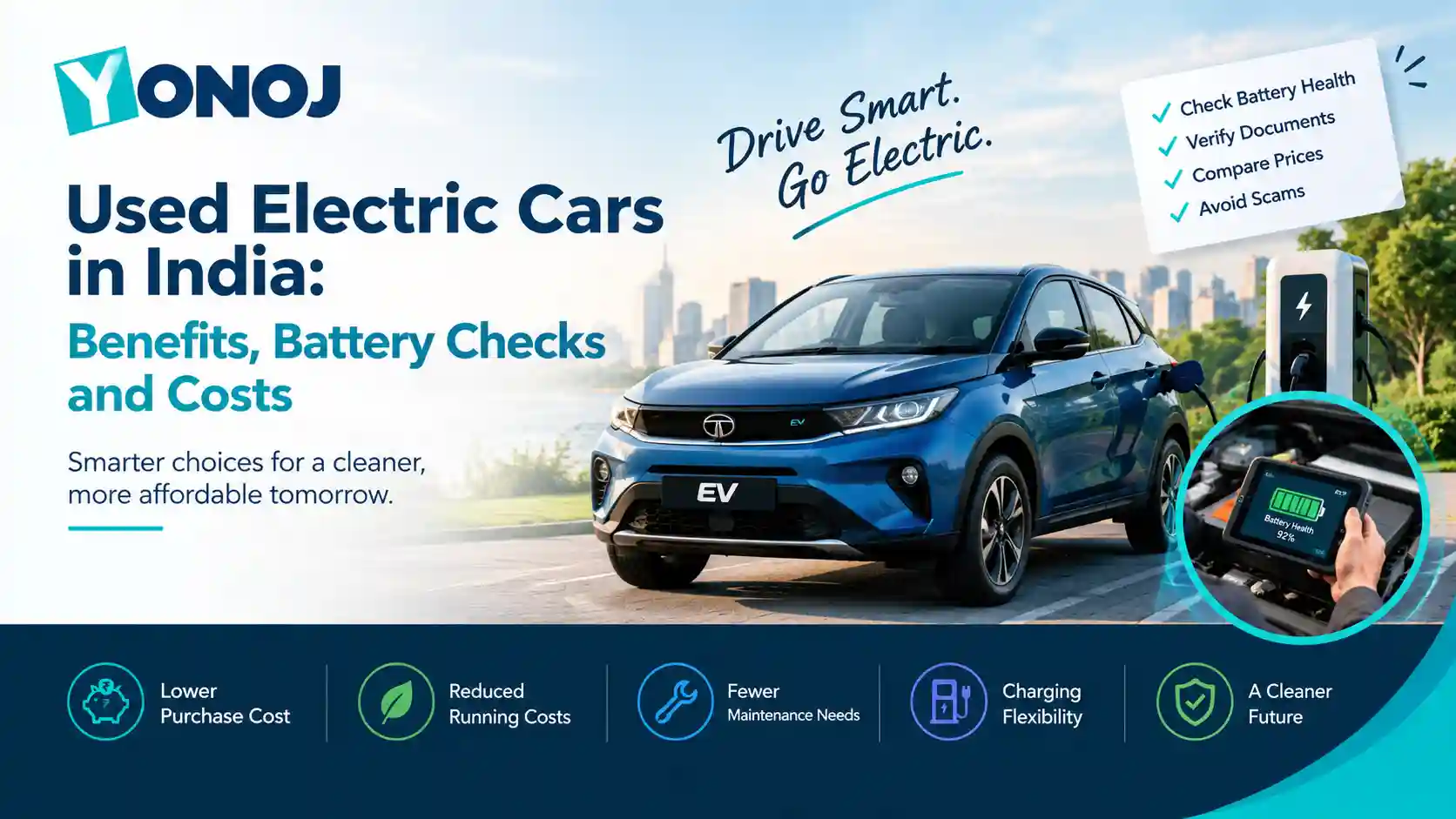
Buying a used electric car in India can be an attractive way to enjoy electric mobility without paying the full price of a brand-new vehicle. As more electric cars enter the pre-owned market, buyers can explore options across different budgets, from compact city cars to electric SUVs.
However, buying a second-hand electric vehicle (EV) requires a different approach from buying a petrol or diesel car. The battery’s condition, remaining warranty, charging compatibility, and actual driving range can significantly affect the vehicle’s value and long-term ownership costs.
If you are considering used electric cars in India, this guide explains their benefits, the essential battery checks, expected running costs, and the documents you should verify before making a purchase.
Why Consider a Used Electric Car in India?
Electric cars can offer several advantages for drivers who want to reduce fuel expenses and simplify routine maintenance. Buying a pre-owned EV may make these benefits more accessible by lowering the initial purchase cost.
1. Lower Purchase Cost
New electric cars can require a substantial upfront investment. A used EV may be available at a lower price because of depreciation, model upgrades, and changing market demand.
Depending on your budget, you might find pre-owned versions of models such as the Tata Nexon EV, Tata Tiago EV, MG ZS EV, MG Comet EV, or Mahindra XUV400.
Availability and prices vary by city, model year, battery size, kilometres driven, and vehicle condition. Compare several listings rather than assuming that a low asking price represents a good deal.
2. Potentially Lower Running Costs
Electric cars use electricity instead of petrol or diesel. Charging at home can be economical, particularly for drivers who cover regular daily distances.
Your actual savings depend on electricity tariffs, charging losses, public charging prices, vehicle efficiency, and your driving habits.
For example, suppose an electric car consumes 15 kWh per 100 km and your effective home-charging cost is ₹8 per kWh. Your approximate electricity cost would be ₹120 per 100 km, before accounting for charging losses.
A petrol car delivering 15 km per litre at ₹100 per litre would cost approximately ₹667 per 100 km.
These are illustrative figures, not guaranteed costs. Your results will vary according to your car, local energy prices, and real-world efficiency.
3. Fewer Routine Maintenance Requirements
Electric cars generally have fewer moving powertrain components than conventional petrol and diesel vehicles. They do not require engine oil changes, spark-plug replacements, or exhaust-system maintenance.
However, EV ownership is not maintenance-free. Tyres, brakes, suspension, air-conditioning systems, coolant where applicable, and electrical components still require attention.
A used EV should be inspected carefully because a battery, charging-system, or high-voltage component repair can be expensive.
4. A Comfortable City-Driving Experience
Electric cars usually deliver immediate acceleration and operate quietly. These characteristics can make them convenient for city commutes, traffic, and short daily journeys.
Regenerative braking can also reduce wear on conventional brake components, although actual wear depends on driving conditions and vehicle design.
For urban buyers with access to convenient charging, a used electric car may be a practical alternative to a petrol hatchback or compact SUV.
Best Used Electric Cars to Consider in India
The right model depends on your budget, daily travel distance, charging arrangements, and space requirements.
| Electric car | Suitable for | What to check |
|---|---|---|
| Tata Tiago EV | City commuting and small families | Battery health, charging history, remaining warranty |
| Tata Nexon EV | Families wanting a compact electric SUV | Battery diagnostics, actual range, service records |
| MG Comet EV | Short urban journeys and compact parking spaces | Range suitability, charging access, cabin practicality |
| MG ZS EV | Buyers needing a larger electric SUV | Battery condition, repair history, charging equipment |
| Mahindra XUV400 | Buyers seeking a more spacious electric vehicle | Battery diagnostics, suspension, charging system |
This is a shortlist to explore, not a ranking. Check the exact model year, battery pack, variant, and equipment before comparing prices.
Also compare the used EV with a new entry-level electric car. A newer vehicle may offer a fresh warranty, updated technology, or a longer usable range that justifies the price difference.
Battery Health: The Most Important Check Before Buying a Used EV
The high-voltage battery is one of the most important components of an electric car. Its condition affects usable driving range, charging performance, resale value, and potential repair costs.
A vehicle can look clean and drive smoothly while still having a battery that has lost a significant amount of its original capacity.
What Is Battery State of Health (SoH)?
State of Health, or SoH, is an estimate of a battery’s current condition compared with its original condition. Depending on the manufacturer and diagnostic method, it may be used to assess remaining capacity and battery degradation.
SoH is different from State of Charge (SoC):
- State of Charge: How much charge the battery has at that moment.
- State of Health: How the battery’s current condition compares with its original condition.
For example, an EV dashboard might show 100% charge even though the battery can no longer store as much energy as it did when new.
How to Check Battery Health
Follow these steps before agreeing to buy:
1. Request a battery diagnostic report. Ask the seller to arrange an inspection at an authorised service centre or a qualified EV specialist. Request available information about battery health, fault codes, charging problems, and previous high-voltage repairs.
2. Check the battery warranty. Confirm the original warranty period, kilometre limit, exclusions, and whether coverage transfers to a second owner. Ask the manufacturer or authorised service centre to confirm the terms for that particular vehicle.
3. Compare the actual driving range. Do not rely solely on the range displayed at full charge. Test the car under suitable driving conditions and compare its energy consumption and usable range with realistic owner reports for the same model and battery variant.
4. Review charging and service history. Ask for service invoices and any records of battery repairs, charging-system faults, or warning messages.
5. Check for accident or underbody damage. Have a qualified technician inspect the vehicle for signs of collision damage, water ingress, or damage near the battery pack. Do not attempt to open or inspect high-voltage components yourself.
6. Investigate unexplained warning messages. Battery, charging, or electrical-system warnings should be diagnosed before purchase rather than dismissed as minor issues.
If the seller refuses a reasonable independent inspection, consider walking away.
For more technical background, see this used EV battery-health guide.
How Much Does a Used Electric Car Cost in India?
There is no single price range that applies to every used electric car. Prices depend on the vehicle’s age, original price, battery capacity, remaining warranty, condition, ownership history, and local demand.
A practical way to evaluate a listing is to compare cars with similar specifications and then adjust your estimate based on their condition.
Consider these factors:
- Age and kilometres driven: Older vehicles may have experienced more depreciation, but mileage alone does not establish battery health.
- Battery condition: A battery with reduced usable capacity may lower the vehicle’s value.
- Warranty remaining: Transferable coverage can be valuable, depending on the terms.
- Accident history: Previous structural or battery-related damage may create additional risk.
- Charging equipment: Confirm which cables and charging accessories are included.
- Service records: Documented maintenance and repairs help you assess the vehicle’s history.
- Local availability: Used EV prices can differ significantly between cities.
Do not estimate a battery replacement bill from a generic online figure. Ask the manufacturer or an authorised repair provider for a model-specific assessment if the battery’s condition raises concerns.
Used EV Running Costs: Electricity, Maintenance and Charging
A low purchase price is only one part of the ownership calculation. Before buying, estimate your likely monthly expenses.
1. Home Charging
Home charging is often convenient for owners with a suitable parking space and an approved electrical installation.
Check whether your home has the required electrical capacity, whether the charger is included, and whether installation work is needed. If you live in an apartment, confirm the society’s permission and charging arrangements before purchasing the vehicle.
2. Public Charging
Public charging may be necessary when home charging is unavailable or during longer trips.
Check charging stations along your regular routes, the charging connectors supported by the vehicle, charger availability, and the applicable fees. Public charging can cost more per unit of energy than home charging.
3. Maintenance and Repairs
Routine maintenance may be simpler than for a petrol or diesel car, but you should budget for tyres, brakes, suspension, air-conditioning maintenance, and other components.
The battery, electric motor, power electronics, and charging system should be checked before purchase. A pre-purchase inspection can help identify issues that might otherwise become costly after the sale.
4. Insurance and Other Ownership Costs
Obtain an insurance quote for the exact vehicle and declared value. Review the policy’s coverage and exclusions, including how battery or electrical-component damage is treated.
You should also consider registration-transfer charges, financing costs if applicable, and any repairs identified during the inspection.
How to Calculate Whether a Used EV Will Save You Money
Use this simple formula to estimate your charging expense:
Monthly electricity cost = Monthly distance ÷ Efficiency in km/kWh × Electricity cost per kWh
For example, assume:
- Monthly driving: 1,200 km
- Efficiency: 7 km/kWh
- Effective electricity cost: ₹8/kWh
The estimated electricity consumption is about 171.4 kWh per month. At ₹8 per kWh, the cost is approximately ₹1,371 per month, excluding charging losses.
Now compare this with a petrol car that delivers 15 km/l at ₹100 per litre. The same 1,200 km would require 80 litres, costing approximately ₹8,000.
The illustrative difference is around ₹6,629 per month before charging losses, maintenance, insurance, and other ownership costs. Actual savings may be lower or higher.
To compare the two cars fairly, include the purchase price, likely resale value, repairs, insurance, financing, and charging access over the period you expect to own the vehicle.
Documents to Verify Before Buying a Used Electric Car
Before making payment, check the documents and ownership history carefully.
- Original Registration Certificate (RC) and seller’s identity.
- Insurance validity and policy details.
- Service records and available battery diagnostic reports.
- Battery warranty documents and transfer conditions.
- Loan or hypothecation status, including any required clearance or NOC.
- Applicable pollution certificate or other documents required by the relevant authority.
- Records of accidents, major repairs, or battery replacement, where applicable.
- Sale receipt and the documents needed to transfer ownership.
Verify the vehicle identification number and registration details against the documents. Complete the applicable ownership-transfer process and retain copies of the signed paperwork.
Requirements can vary by state and vehicle circumstances, so confirm the current process with the relevant RTO or official transport portal.
Common Mistakes to Avoid When Buying a Used EV
Buying Only Because the Price Is Low
A heavily discounted EV may have limited range, expired warranty coverage, unresolved faults, or a history of damage. Compare the full condition and likely ownership cost, not just the asking price.
Ignoring Charging Access
A used EV may be inconvenient if you cannot charge at home or have few reliable public chargers near your regular routes. Check your charging options before you commit.
Assuming the Battery Warranty Transfers Automatically
Warranty conditions vary by manufacturer, model, ownership history, and use. Confirm transferability directly with the manufacturer or authorised service centre.
Relying on the Dashboard Range Alone
The displayed range is an estimate that can change with temperature, driving style, traffic, and air-conditioning use. Use diagnostic information and a suitable road test to make a better assessment.
Skipping a Professional Inspection
A general used-car inspection is useful, but an EV also needs appropriate checks of its battery, charging system, and high-voltage components. Choose a technician with relevant EV expertise.
Where to Start Your Used-Car Search
Once you have set your budget and decided what range you need, compare listings, ownership history, condition, and running costs before contacting sellers.
You can also explore Yonoj to discover local businesses and services that may help with your vehicle-related needs. For an EV purchase, look specifically for qualified inspection providers or authorised service centres that can assess the vehicle you are considering.
Ask the seller for documentation in advance, arrange an independent inspection, and avoid making a non-refundable payment before you have verified the car and the transaction.
Conclusion
Buying a used electric car in India can be a cost-effective way to enjoy electric mobility, especially if your daily driving needs match the vehicle’s real-world range and you have convenient charging access.
The most important step is to evaluate battery health rather than judging the car by appearance or price alone. Confirm the warranty terms, review the service history, inspect the charging system, estimate your electricity costs, and complete the paperwork correctly.
A carefully inspected used EV can offer excellent value. Take your time, compare alternatives, and make the final decision based on the vehicle’s condition and your long-term ownership needs.
Frequently Asked Questions
1. Is buying a used electric car in India worth it?
It can be worth it if the purchase price is reasonable, the battery is in good condition, the remaining warranty is understood, and the car meets your range and charging needs. An independent inspection is essential.
2. How do I check the battery health of a used electric car?
Request a battery diagnostic assessment from an authorised service centre or qualified EV specialist. Review available battery-health data, fault codes, service records, charging history, and real-world range.
3. How long does an electric car battery last?
Battery life varies by chemistry, model, thermal management, usage, charging conditions, climate, and maintenance. Check the manufacturer’s warranty and battery-specific guidance for the vehicle rather than assuming a universal lifespan.
4. Is the battery warranty transferable to a second owner?
It depends on the manufacturer and the warranty terms. Confirm the remaining coverage, applicable kilometre limit, exclusions, and transfer conditions directly with the manufacturer or an authorised service centre.
5. Are used electric cars cheaper to maintain than petrol cars?
They can have lower routine powertrain maintenance costs because they do not need engine oil changes or many conventional engine components. However, tyres, suspension, brakes, electrical systems, and battery-related repairs still need to be considered.
6. Can I charge a used electric car at home?
Usually, provided your parking arrangement, electrical installation, and vehicle charging equipment are suitable. Apartment residents should confirm permission and installation arrangements with their housing society or property manager.
7. What is the biggest risk when buying a used electric car?
One of the biggest risks is buying a vehicle with a degraded or damaged battery without understanding the remaining range, warranty coverage, and potential repair costs. A qualified inspection and written warranty confirmation can help reduce this risk.
8. Which used electric car is best for city driving?
Compact models such as the Tata Tiago EV and MG Comet EV may suit urban driving, depending on your space and range requirements. The best choice depends on the specific variant, battery condition, price, and charging access.