
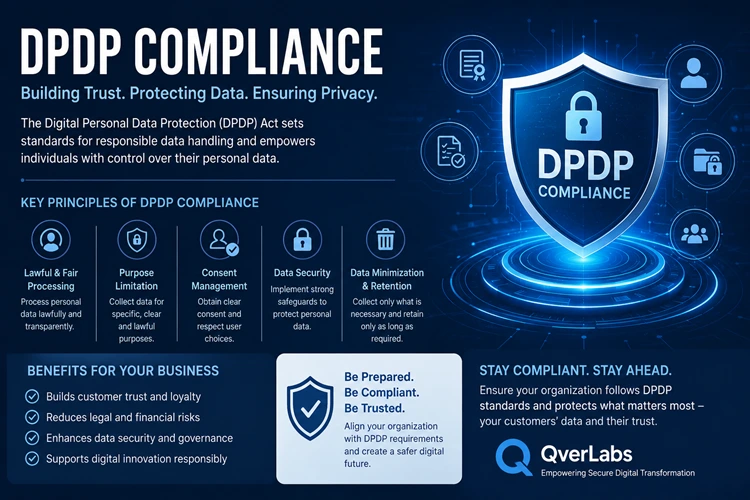
India’s Digital Personal Data Protection (DPDP) Act has revolutionized the management of personal data in the country. As companies deal with this regulatory framework, it becomes crucial to grasp the intricacies of compliance with the DPDP. As a startup or a well-established business, effective data protection strategies can help you ensure compliance with regulations and maintain customer trust. QVerLabs offers organizations ongoing support and technology to ensure full compliance with DPDP, bringing their offerings to a new standard.
DPDP Compliance means what?
Compliance of DPDP is following the rules of Data Protection Act, 2023 which is the big landmark legislation related to data protection in India. This is a framework that regulates the collection, processing and storage of personal data from the citizens of India. All businesses, from large corporations to small ones, in all industries, must have DPDP compliance for any enterprise that processes personal data.
Promotes responsible data handling practices, while adhering to individual privacy rights, the DPDP Act emphasizes. To avoid penalties, legal ramification and damage to their reputation, organizations need to put measures in place to ensure that they are DPDP compliant.
The key points for DPDP Compliance are listed below:
Organizations are obligated to be transparent in data processing activities, making it easier to meet DPDP compliance. People need to be informed of what data is being collected, how it is being used and by whom. QVerLabs helps businesses record these to ensure that they meet DPDP compliance requirements.
To comply with DPDP, personal data cannot be processed unless explicit consent is obtained. The organizations have to respect a person’s rights, like deletion, correction and access rights. These are important for achieving DPDP compliance.
In order for a company to be considered DPDP Compliant, there are certain requirements it must meet.
The Data Protection Officer (DPO) has a wide array of roles to play.A Data Protection Officer (DPO) is equipped with several duties to handle.
The requirement to have a Data Protection Officer to help manage compliance activity is often part of DPDP compliance. The DPO monitors compliance with the DPD and takes care of the matters of the data subjects.
Incorporating privacy at the heart of business processes guarantees DPDP compliance. Data Protection Impact Assessments (DPIA) should be carried out to pinpoint and lower risks that arise when implementing DPDP compliance.
How to make sure that DPDP compliance is put into practice within your organization.
Start working towards DPDP compliance by tracing all personal data in your organization. Define data sources, processing operations and storage locations to determine pre-findings status of DPDP compliance.
Formulate policies for privacy protection.Create Privacy Policies.
Develop extensive privacy strategies that deal with the needs of DPDP compliance. Such documents should be drafted in a manner that is clear for the abovementioned data collection, user rights and retention policies in relation to the compliance with DPDP are clearly explained.
Implement security measures once there is access to the site.Implement security measures when access is gained.
To comply with DPDP, the company needs to have a solid security framework. Use encryption, access controls and frequent security audits to safeguard personal information and keep standards for DPDP complied with.
Write Data Processing agreements.To keep on writing Data Processing agreements.
Have formal agreements between third parties and vendors for compliance to DPDP. Data Processing Agreements (DPA) prescribe obligations for implementations and ensure uniform compliance to DPDP throughout your ecosystem.
Some of the most widespread DPDP compliance issues include the following:
Challenge 1 will involve integrating with legacy systems.Challenge 1 will be integrating with legacy systems.
Legacy systems pose technical challenges to integrate with the requirements of DPDP. Businesses face issues in merging with the latest technology while keeping DPDP compliant with the existing infrastructure.
Challenge 2 is a brief description of a second challenge.Challenge 2 is a short description of another challenge.
The compliance of DPDP will limit transfers of international data. While meeting the requirements of data protection, organizations need to be keenly attuned to DPDP compliance requirements while helping to ensure that the protection of the data of Indian residents does not pose harm to global customers.
Staff Training and Awareness – Challenge 3.Participating in staff training and awareness is an important aspect of Challenge 3.
Understanding by the organization is the key to achieving DPDP compliance. In many businesses, there are trouble spots around training staff on the issue of DPDP and how to comply with it, and what is the best practice.
QVerLabs provides support for compliance with DPDP.QVerLabs can help with DPDP compliance.
QVerLabs offers a full range of solutions for organizations looking for DPDP compliance. Our team is available for policy development, technical implementation and services to carry out audits to ensure that a business is compliant with DPDP. We are able to assist businesses to become familiar with DPDP compliance and implement sustainable practices.
Penalties for Non-Compliance
Non-compliance of organizations with DPDP can have severe repercussions. In case of the DPDP Act, the penalties range up to ₹250 crore in case of serious violations and up to ₹500 crore in case of any systematic violations. It’s therefore fundamental to comprehending DPDP compliance if you want to safeguard your organization’s interests.
How to prepare for compliance with DPDP.What steps are required for DPDP compliance audits.
Frequent DPDP compliance audits ensure that regulations are followed. There should be a record of its DPDP compliance-related activities, audit trails and regularly review it to illustrate that it is compliant.
Conclusion
Complying with DPDP is an important investment of organization integrity and customers trust. Comprehensive measures and keeping up to date with DPDP compliance requirements can help businesses sail through India’s data protection landscape. QVerLabs continues to strive to assist organizations become and stay DPDP compliant.
Let’s address some common questions regarding DPDP compliance.Let’s take a look at some of the most common questions related to DPDP compliance.
Q1: When will DPDP compliance be effective?
A: The DPDP Act requirements must be complied with as soon as the Act comes into play. The specific timelines for the compliance of the DPDP provisions may differ, therefore it is recommended to implement it as early as possible.
Q2: So is there a need for small businesses to have DPDP compliance?
A: Yes, compliance with the DPDP (Data Protection Directive Principles) covers all organizations irrespective of their size which hold data related to Indian residents. No matter the size of the business, there will be requirements for DPDP-implementing measures.
Q3: If we fail to become DPDP compliant, what will happen?
The consequence of failing to be Non-DPDP compliant is significant penalties, legal action and damage to the brand. The severity of the violation can attract fines up to ₹ 250-500 crore for the organizations.
Q4: How often should DPDP Compliance be carried out?
A: Audits of compliance with DPDP should be performed once a year or when there is a significant change in the business processes. A regular DPDP compliance review helps to achieve ongoing compliance.
Q5: Is QVerLabs able to provide support for implementing DPDP compliance?
Yes, QVerLabs focuses on DPDP compliant solutions, such as creating DPDP policies, implementing technical solutions and DPDP compliance verification.
Q6: What’s the difference between DPDP and GDPR?
Although both focus on data protection, DPDP law is unique to India and has its own requirements which will necessitate a DPDP compliance strategy that is different to GDPR.